A group of seven Red Coats, on the signal of an officer, fired into a crowd of civilians. Three lie bleeding on the ground and two casualties have been lifted by the crowd. Behind the British troops is the Royal Custom House, which bears the sign “Butcher’s Hall.” Beneath the print are 18 lines of verse and a listing of the “unhappy Sufferers” Saml Gray, Saml Maverick, James Caldwell, Crispus Attucks, and Patrick Carr (killed).
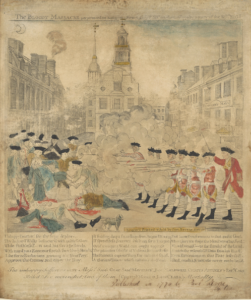
Jonathan Mulliken was a clockmaker in Newburyport. His version pf the engraving of the scene of the Boston Massacre was based on Paul Revere’s print (with minor differences) and was most likely issued in Newburyport, ca. 1770. In other depictions of the event (like the one seen below), Crispus Attucks is at the center of the scene. Crispus was a sailor of Nipmuc and African descent, yet Revere omitted this detail in his etching. One might speculate that the print might have lost its impact as a propaganda document if a Black man was highlighted.

By the 1850s, 80 years after the Boston Massacre, abolitionists resurrected Crispus Attucks as a powerful symbol of resistance and sacrifice. John H. Bufford’s print places Attucks at the center of the event as a heroic martyr as he was known to be a respected sailor.
Importantly he escaped from slavery and to avoid being caught, went by the alias Michael Johnson. Long sea voyages were smart ways to disappear and reinvent oneself. He was scheduled to sail with Capt. Folger on a long whaling voyage only days after this tragedy took place.
Both the 1770 and 1850s portrayals of the Boston Massacre—and of Attucks himself—were shaped to influence public opinion. In the Revolutionary period, these depictions supported the call for independence from Britain; during the antebellum era, they served the abolitionist cause.